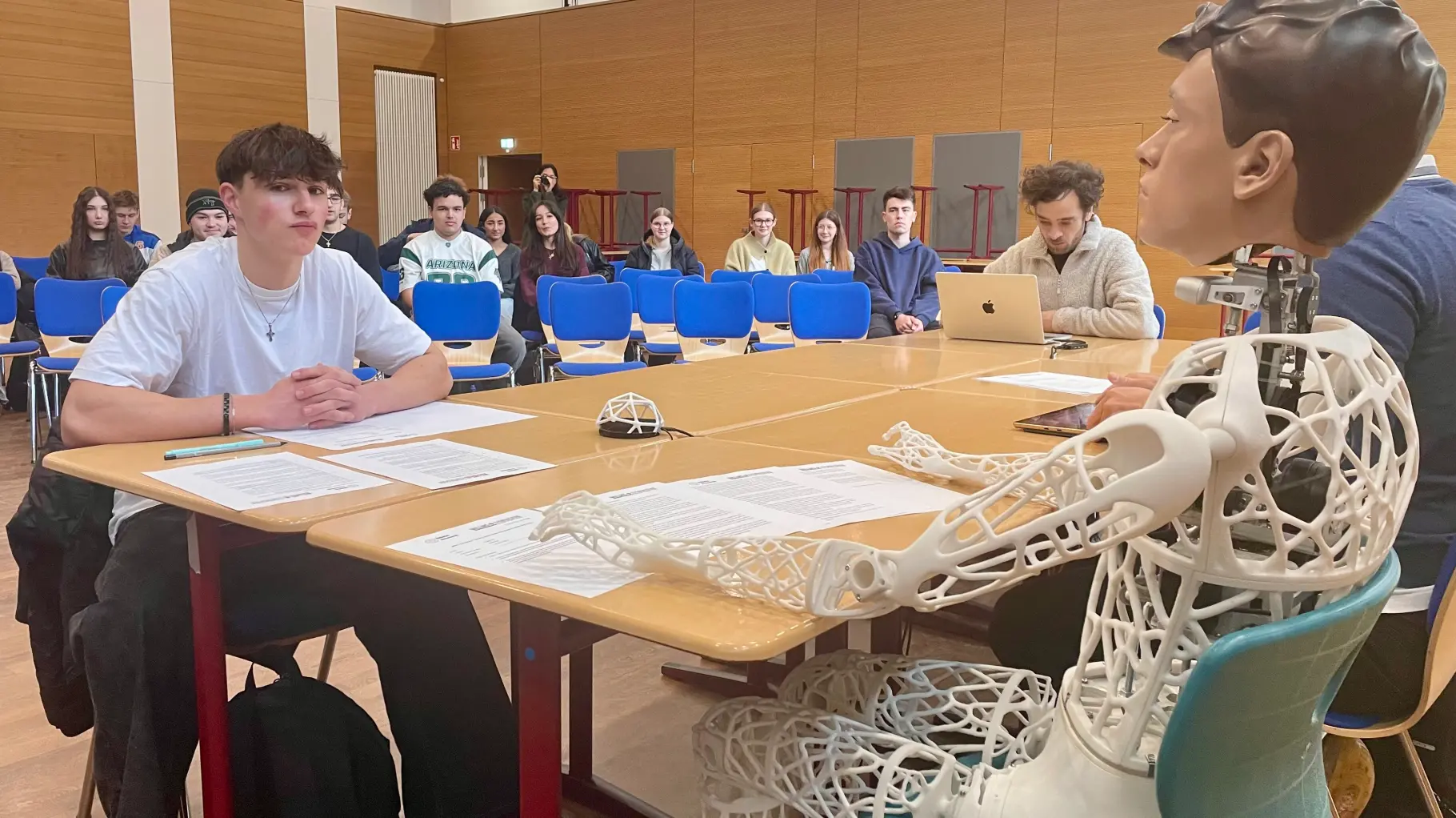
Adaptive examination
Captcha responded to student answers and generated follow-up questions rather than reading a fixed questionnaire.

See Captcha conduct an Abitur oral examination in Germany and operate as an autonomous social robot at CES in Las Vegas.
Real rooms are harder than demos. People interrupt, speak from different distances, change the subject, react emotionally and expect a robot to understand the social timing of the exchange. That is why IronHeart.AI is developed through embodied deployments rather than transcript benchmarks alone.
In April 2026, Hidoba Research participated in a European premiere at Willms-Gymnasium in Delmenhorst, Germany. Captcha—the team’s humanoid robot powered by IronHeart—conducted a live simulation of the school’s oral Abitur examinations.
Captcha acted as the examiner: it asked the initial questions, interpreted each answer and generated relevant clarification and follow-up questions as the examination progressed. The case made the complete cognitive loop observable inside a consequential, structured conversation.
At CES in Las Vegas, the same runtime moved from structured conversation to embodied social action. Captcha navigated the live exhibition environment, approached visitors, introduced itself, sustained spontaneous conversations and adapted when a person did not engage.
A configurable cognitive runtime—not a one-size-fits-all robot personality. Partners purchase managed Cloud API access or scope edge, offline, private-cloud and OEM production licensing with integration support.
Captcha responded to student answers and generated follow-up questions rather than reading a fixed questionnaire.
At CES, conversation was connected to autonomous movement and live social encounters on the exhibition floor.
Missing engagement became a runtime event, allowing Captcha to change timing, try another prompt or move on.

The humanoid robot asked the initial questions, listened to each response and generated clarification and additional questions as the oral examination developed.
Students and educators described Captcha as technically competent and able to adapt its questions. Their reaction was measured rather than dazzled—useful evidence that the experiment was assessed as a working examination system, not only as a spectacle.
Perception followed the active student. Realtime voice conducted the exchange. Memory preserved the exam thread. Personality maintained the examiner role. Gaze coordinated attention. Actions selected follow-up questions and produced a structured result. Remove any one of these layers and the robot stops behaving like an examiner and falls back to a disconnected voice interface.
At CES in Las Vegas, Captcha operated as an autonomous social robot—moving through the exhibition space, approaching visitors, introducing itself and holding spontaneous conversations.
The most revealing behavior happened when a conversation did not begin. If a visitor ignored the approach or did not answer, IronHeart treated the absence of engagement as a social signal. Captcha could adjust its timing, try a different prompt or disengage and continue through the space instead of repeating a fixed script.
Perception detects people and attention. Realtime voice opens and sustains the exchange. Memory preserves the encounter. Personality determines how Captcha introduces itself. Gaze signals who it is addressing. Actions connect the interaction to autonomous movement—one continuous Cognitive Runtime operating in the physical world.
A useful embodied system cannot treat voice, memory and action as unrelated calls. IronHeart coordinates the modules around the live person, environment, role and task.
Each module can be configured per robot or product while published versions preserve a reproducible operational state.
Detect people, attention and environmental changes in a shared physical space.
Realtime voice manages introductions, questions, answers, timing and interruption.
Connect the social interaction to approved autonomous movement and embodied actions.
Use response or non-response to select a relevant next behavior instead of repeating a script.
Primary buyer: Robot OEMs, education-technology teams, research institutions and integrators evaluating embodied AI in structured and open public environments.
What to measure: Assess conversational timing, attention, interruption recovery, appropriate initiative, safe action completion and adaptation to missing engagement.
Required controls: Role personality, approved knowledge, session memory, attention behavior, action and navigation boundaries, follow-up policy and human review.
Prototype and launch with managed realtime runtime services and the published API plans.
Review pricing →Scope interaction-critical components for supported device or nearby edge hardware.
Discuss edge deployment →Run inside customer-controlled infrastructure with an enterprise integration agreement.
Request enterprise scope →| Foundation model for | Social interaction across perception, voice, memory, personality, gaze and actions. |
|---|---|
| Partner retains | Hardware, customer experience, business rules, data policy, safety authority and go-to-market. |
| IronHeart provides | Runtime configuration, cognitive modules, adapter contract, versioned publication and deployment support. |
| Commercial path | Cloud API subscription for evaluation; custom scope for edge, offline, private cloud and OEM production. |
At Willms-Gymnasium in Delmenhorst, Germany, in April 2026, with participation from Hidoba Research.
Captcha acted as an oral examiner: asking questions, responding to answers and generating clarification and follow-up questions.
In the reported biology example with Miriam Hollmann, Captcha arrived at a 1− result that the human teacher also confirmed.
In Las Vegas, Captcha moved through the exhibition environment, approached and spoke with visitors, introduced itself and adapted when a person did not respond.
Together they combine perception, realtime voice, memory, stable personality, coordinated gaze, adaptive follow-ups and approved embodied actions including movement.
Tell us about the embodiment, use case and deployment constraints. We will map the fastest evaluation path.